


Where to go in Haleakalā National Park

Haleakalā National Park (huh·lay·aa·kuh·laa) has a deep connection with both traditional and modern Hawaiian culture, protecting the relationship between the land and its people. The park also protects endangered species, some found nowhere else. Visit this extraordinary place to connect with nature among volcanic landscapes and sub-tropical rainforests with unforgettable hikes through the backcountry.

Located on the island of Maui, Haleakalā National Park stretches from the 10,023-foot summit of Haleakalā down the southeast slope of the mountain to the Kīpahulu coast near Hana. Sadly, the park's two sections are not directly connected by road, but both are accessible from Kahului.
In this blog post, we focus only on the mountainous summit area. We didn't have enough time to drive the road to Hana or visit the coastal Kipahulu area (takes nearly 3 hours to reach). And, despite the foggy conditions at the summit, there was plenty to see, and we thoroughly enjoyed our visit.
To reach this destination, you'll need to take a flight. We are from the Midwest and flew to Oahu for a week. During our stay, we decided to take a day trip to Maui specifically to visit Haleakalā National Park. The Hawaiian Airlines flight takes just an hour and costs about $100 roundtrip per person.

Our journey started very early. We departed Oahu at 7 am and arrived around 8 am in Maui at the Kahului airport. The airport is small and straightforward. We were able to deplane, get a rental car and get on the road within 30 minutes.
Since there are NO SERVICES in the park, we stopped at McDonald's to refuel our stomach before heading to the summit. And, purchased some snacks at the local convenient store.

In about 55 minutes, you will find yourself at the National Park entrance, and just prior to that, the Haleakalā National Park sign.

Although we weren't able to arrive in time, the Summit at Sunrise is a very popular activity to do in the park. After all, Haleakalā means "House of the Sun" in Hawaiian. I can only imagine watching the sun rise over the clouds with the stars above shining brightly.
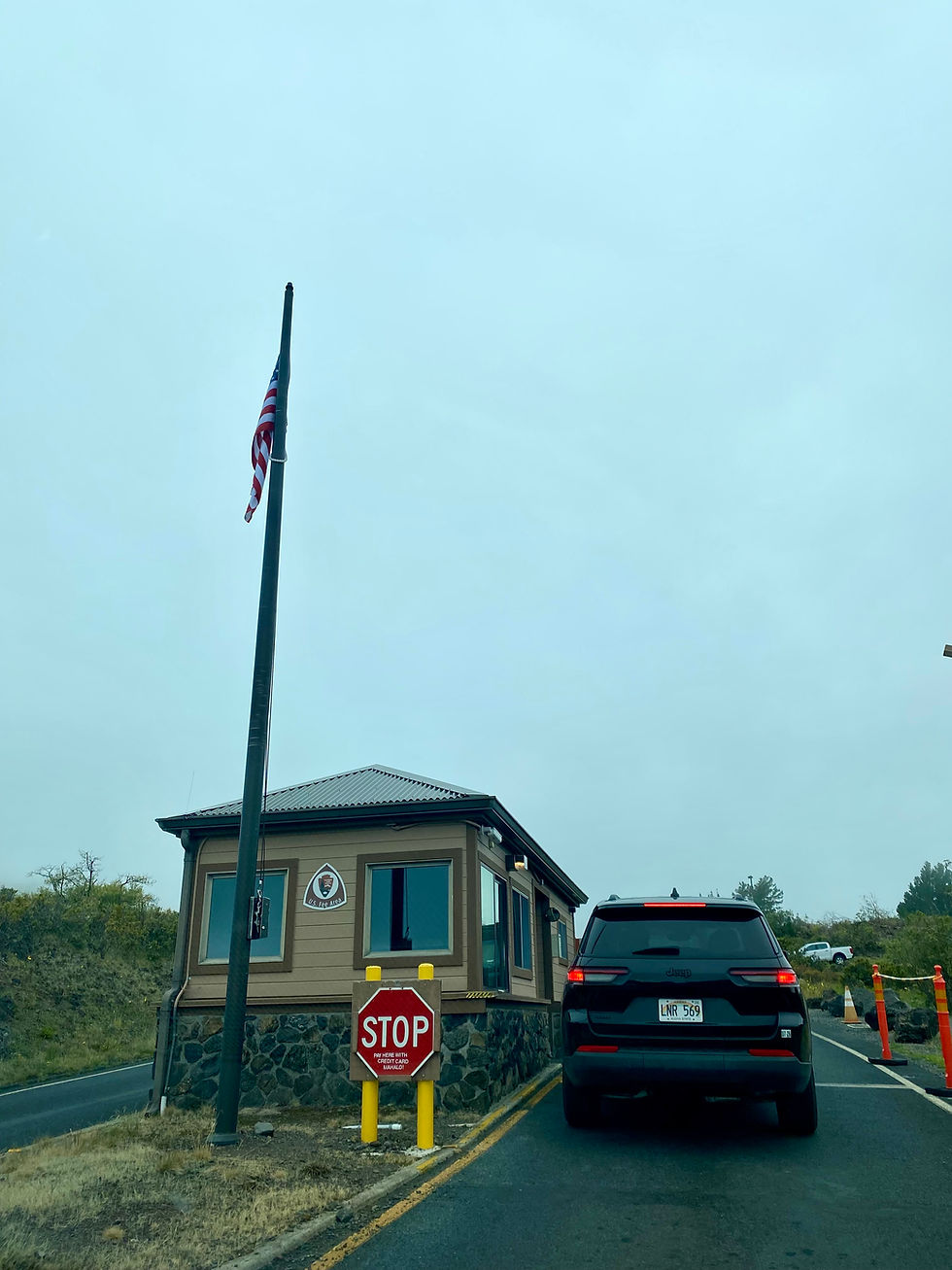
Because of its popularity, there is a timed entry reservation (cost is $1) needed to visit. It is needed for each vehicle entering the park between 3:00 a.m. and 7:00 a.m. and you can book a reservation up to 60 days in advance.
The price to enter the park is $30 per vehicle. Other pricing, such as motorcycles, can be found here.
Haleakalā National Park Visitor Center/Headquarters
Our first destination is the Haleakalā National Park Headquarters Visitor Center, where you can use the facilities, purchase souvenirs, and speak with a park ranger about any questions with your itinerary. Although the visitor center is not near the entrance to the park, we took the extra 22 minute drive to come here first.
Hosmer Grove Trail
Although we had to backtrack towards the park entrance about 20 minutes, our first stop is Hosmer Grove Trail. This short .6 mile loop trail meanders through a forest of conifers and eucalyptus and native shrubland.

Here, we had the opportunity to see and hear the native Hawaiian honeycreepers and the endangered I'iwi. It was so nice to observe such a beautiful and indigenous bird in its natural habitat.


For any bird enthusiast, this area is a great place to observe numerous unique birds and experience an auditory sensory overload. We were able to see the Hawaiʻi ʻamakihi, I'iwi, Honeycreeper, ʻApapane, Warbling white-eye and the Chinese Hwamei.
We explored this area for nearly an hour, even though the trail is quite short, as we frequently stopped to observe the birds.
Leleiwi Overlook
To reach Leleiwi Overlook from Hosmer Grove trail takes about 20 minutes by car. Leleiwi Overlook in Haleakalā National Park is a great overlook that is easily reached. A small parking area is located just across the street. Simply cross the street from the parking lot to the trail, which is .3 miles rountrip and is located at 8,800 feet. Take in panoramic voews of the crater, cinder cones and Ko'olau Gap.

This trail is easy to moderate, unpaved, and rocky, with a 100-foot elevation change. It's often chosen as a quieter alternative to the summit for sunrise. Near the trailhead, you'll find remnants of a stone wall constructed by ranchers in the late 1800s to help guide cattle through the challenging terrain.
Plan to spend about 20 minutes here. Just in the few minutes we were at the overlook, the clouds changed drastically, giving our view a whole new perspective.


Keonehe'ehe'e (Sliding Sands) Trailhead
The next stop (just a short 7 minute drive from Leleiwi Overlook) is the Keonehe'ehe'e (Sliding Sands) Trailhead and another Visitor Center. After visiting the Visitor Center to utilize their restrooms and learn more about the area we began our hike downhill into the crater. The trailhead is located in the Haleakalā Visitor Center parking lot near the road. The distance to the first overlook is 0.50 miles (0.8 km) round trip, with an elevation change of 50 ft (15 m).
While we just stopped a little past the first overlook at a .5 mile in this trail continues for 11-miles (17.8 km), which is a full-day hike. It crosses the valley floor, and ends at Halemau'u (7,990 ft/2,436 m elevation).
It's also known as Sliding Sands for a reason. The trail is steep, loose volcanic ash and cinder, which is why hikers often "slide" down, giving the trail its name.

The views from the first overlook are breathtaking and otherworldly.
We spent about 45 minutes walking this trail and back. This was definately the highlight of my trip to this park.

Pā Kaʻoao Overlook
Here you can view ancient rock wall shelters and the craters. The walk is very short and the views are spectacular as long as the clouds aren't obstructing your view.
The Pā Kaʻoao Overlook is a short 0.2 mile (0.32 km) hike up the hill next to Haleakalā Visitor Center.
Clouds rolling in at Pā Ka‘oao trail Pā Ka‘oao trail overlook View from Pā Ka‘oao trail

Puʻuʻulaʻula/ Summit Observation Deck
Puʻuʻulaʻula, also known as the Summit Observation Deck, is the tallest point in the park and on the island of Maui at 10,023 feet (3055 m).
If you've reserved a spot to watch the sunrise at the summit, this is where you should be. Drive up here to see the sun rising over the crater or simply to gain a wider perspective of the world around you. Weather permitting, you can enjoy expansive 360-degree views of the crater, telescopes, the West Maui mountains, surrounding islands, and the Pacific Ocean. The summit building offers protection from the wind while still providing viewing opportunities through wraparound windows.


Unfortunately, by the time we made it to the Summit Observation Deck the clouds had rolled in and our visability became zero.
A major attraction for many visitors reaching the summit is seeing the rare ʻāhinahina, or silversword. This unique variety exists only at Haleakalā. The ʻāhinahina demonstrates amazing adaptation—its silvery hairs shield it from harsh sunlight and help to gather moisture from the mountain mist. These intriguing plants can survive for over 30 years, but they bloom only once in their lifetime. After producing a tall stalk of purple flowers, the plant dies.

Our visit to the stunning national park has ended. We had just enough time to make the 1 1/2 hour trip back to Kahului Airport and catch our flight to Oahu. I am looking forward to returning to this park to explore the forests and waterfalls of the picturesque coastal Kīpahulu District in Haleakalā National Park.

Before visiting Haleakalā National Park read this information which can be found on the National Park Service website, and is 100% true!
While visiting we were not prepared for the cooler temps. Luckily, we were able to buy our souvenir shirts to help keep us warm. And, we made sure to fill up our gas tank.
Dress warmly. Be prepared for all kinds of weather. Temperatures at the summit are at least 20 degrees colder than at sea level and often drop below freezing.
Fill up your gas tank and bring food. Neither are available in the park.
There are no charging stations for electric vehicles at Haleakalā National Park. Even electric vehicles with a full charge have been unable to make it to the Summit.
Bring water and sunscreen and wear sturdy shoes.
Pay the entrance fee with a credit card.
Always respect speed limits. The park road goes through endangered species habitat.
Please leave natural resources and cultural artifacts, rocks, and structures alone.
Please be quiet and respectful. The summit is sacred to Native Hawaiians.
The summit is remote. Emergency medical assistance is at least one hour away.


Comments